In 1994 Rodney Wilson a Missouri teacher nominated October as Gay History Month to celebrate queer history. October was significant because it was the month in which the first two queer marches on Washington (in 1979 and 1987) took place. One of the outcomes of the 1987 march was the February 1988 War Conference at Airlie House in Warrenton, VA where it was decided to have an annual Coming Out Day on October 11th (the date of the second march on Washington).
Philadelphia's Equality Forum has recently resurrected the queer history month with profiles of key LGBT figures each month at the GLBT History Month site. This year, on October 14th, Patsy Lynch, a Rainbow History Board member and well-known documenter of the gay community in Washington, DC, will be profiled on the history month site.
Saturday, October 2, 2010


Catching up and moving on ...
It has been a long while since I last posted on Visible Past. Now that I am no longer heading Rainbow History Project, I hope to have time to catch up on our Visible Past.
September's slew of suicides has also spurred me back to the keyboard. It shouldn't have to be hell to be a gay kid but it has long been that way. A very good article by Brian Moylan, on Gawker, maps the agony of gay teens: What It's Like to Be a Gay Teen .
Among DC's first gay activist efforts by the Gay Liberation Front at 1620 S St NW and Deacon Maccubbin's Earthworks on 20th St NW were the scheduling of support groups for gay youth, especially those living on the streets.
Tuesday, November 17, 2009
And speaking of preservation ...
It has been almost exactly 9 months since the District of Columbia's Historic Preservation Review Board declared the home and office of Dr. Frank Kameny a historic landmark in the District. It is still only a local landmark.
Rainbow History had expected, hoped, that the next step would be taken by the Historic Preservation Office: nominating the site for the National Park Service's Register of Historic Sites.
Hasn't happened. We're still hoping. Unfortunately this isn't something Rainbow History itself can do. The nomination has to be made by the state/District historic preservation officer to NPS.
Losing the Blade, Saving Our History
November 16th, 2009 the sun set on the Washington Blade, Washington DC's venerable newspaper of record for the queer community. Forty years and 41 days since Nancy Tucker and Art Stone launched the periodical on October 5, 1969, Window Media's misadventures sank the paper. The venerable local and national institution is lost. But the good news is that its staff are working to recreate again under another name in an employee-owned venture.
But that won't save our history!
Now that the entire Window Media organization is in receivership and owned largely by the Small Business Administration, the Blade's collection of forty years of photos (beginning with Nancy Tuckers' photos) is in jeopardy and may be lost to the community. Forty years of the company's records, topical files, and journalists' files are in equally serious jeopardy.
Historic preservation is about preserving memories. Certainly preserving the documentary and photographic archives is as, if not more important, than preserving sites in our history.
What will our queer community - local and national - do to ensure that those archives are not lost, dispersed, or junked by the Small Business Administration?
Tuesday, March 3, 2009
It's Time
The plaque stands across the street from the Stonewall Inn just behind Segal's unthreatening same-sex statues.
Ten years ago a group of historians, preservationists, and archivists nominated New York's Stonewall Inn as a historic site. The nomination was taken up enthusiastically by New York's State Historic Preservation Office which landmarked the site and then pushed the nomination to the National Park Service where in 2000 the Stonewall Inn joined the other 2000 plus National Historic Landmarks. It is still the only queer site on the national list.
It's time the National Park Service recognized this queer civil rights struggle by adding sites important to the lesbian, gay, bisexual and transgender communities.
It's time.
Wednesday, December 17, 2008
What's Left of Our Communities?
So ... there used to be a couple of offices in LA where the Mattachine Society and Foundation operated. Gone - now a parking lot and a modern office building. There used to be a whole neighborhood of clubs and entertainment spots in DC, including the city's longest running and best drag show. Gone - obliterated when the city fathers wanted to build a baseball stadium for a team so bad that Montreal sold it.
Can we start saving our historic places instead of kissing them goodbye?! Queer America is still getting into the history business - writing up its past and collecting its documents and artifacts. We have hardly even begun preserving our historic sites. Ten years ago the Stonewall got listed as a historic national landmark. Nothing else has made the list. No one has pushed anything else on to the list. Between California and New York, virtually nothing has been saved or preserved, with the exception of Henry Gerber's house in Chicago. [see earlier posts]
Forty years after Stonewall, it's time for local queer communities to tally up the spots that celebrate their history, document them and get them onto the historic preservation/landmark lists before they're gone. And where there is already local preservation as with Milk's home and camera shop and Gerber's home, local communities need to press their state historic preservation officer (that's what they call the guy who recommends sites to the national register) to submit those local sites to the National Register of Historic Places run by the National Park Service, and maybe even to the National Historic Landmarks list.
With a new administration coming in, there is more of a chance that queer history won't be shoved into a closet the way it was during the Bush years.
We're a people with a past and we're a people with historic places. We need to keep those places safe, organize walking tours, and invite straight society to learn about our civil rights struggle.
Wednesday, December 10, 2008
DC's Kameny Historic Site
It couldn't be more historic or prominent in LGBT civil rights history: 5020 Cathedral Avenue NW, just a couple of blocks up the hill from MacArthur Boulevard in the Palisades -- is Frank Kameny's home and office.
This is where the self-affirming slogan of the Sixties' gay civil rights campaigns, GAY IS GOOD, was born. This is also where discussions and planning for regional and national gay civil rights organizations went on, where picketing plans were made, where campaigns against civil service and military discrimination were launched, and where the first campaign of an 'out' gay man for Congress was hatched.
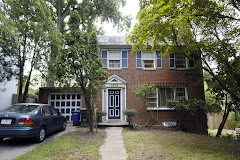
Kameny moved there in 1962, from his 4th floor walkup on 18th St NW where he lived on 20 cents a day after being fired from his government job, renting at first and later buying the house. That's it there in the column on the right of this blog page.
The year before he moved to Cathedral Avenue, Kameny and Jack Nichols started the Mattachine society of Washington and completely turned the somewhat reserved world of homophile rights on its head with picketing, in-your-face legal battles, interviews (print, radio, and TV), and taking on the federal government, the psychiatrists' professional organization, and the religious community.
The little neo-colonial house with the patterned blue and white trim was at the center of national and local campaigning for gay civil rights from the early 1960s to the mid-1970s. The upstairs bedroom overlooking the front yard (under Kameny's distinctively patterned shingles) has been Dr. Kameny's office for years. Here he met with members of the local Mattachine Society, with leaders of other gay civil rights groups, and with friends in the movement.
Forty-six years after Kameny moved in and forty-seven years after he stood up to federal employment discrimination and launched a militant campaign for equal rights for homosexuals, the little house at 5020 Cathedral NW, Washington, DC deserves preservation and recognition as a site at the center of a minority's assertion of equality and rights.
Rainbow History has nominated the Kameny home and office as a historic site. The District of Columbia's Historic Preservation Review Board will decide whether to accept that nomination on January 22, 2009. To read the nomination check out the pdf file at www.rainbowhistory.org/5020Cathedral.pdf.
Subscribe to:
Posts (Atom)

 Posts