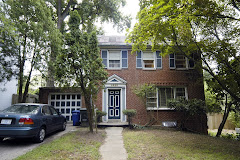
So ... there used to be a couple of offices in LA where the Mattachine Society and Foundation operated. Gone - now a parking lot and a modern office building. There used to be a whole neighborhood of clubs and entertainment spots in DC, including the city's longest running and best drag show. Gone - obliterated when the city fathers wanted to build a baseball stadium for a team so bad that Montreal sold it.
Can we start saving our historic places instead of kissing them goodbye?! Queer America is still getting into the history business - writing up its past and collecting its documents and artifacts. We have hardly even begun preserving our historic sites. Ten years ago the Stonewall got listed as a historic national landmark. Nothing else has made the list. No one has pushed anything else on to the list. Between California and New York, virtually nothing has been saved or preserved, with the exception of Henry Gerber's house in Chicago. [see earlier posts]
Forty years after Stonewall, it's time for local queer communities to tally up the spots that celebrate their history, document them and get them onto the historic preservation/landmark lists before they're gone. And where there is already local preservation as with Milk's home and camera shop and Gerber's home, local communities need to press their state historic preservation officer (that's what they call the guy who recommends sites to the national register) to submit those local sites to the National Register of Historic Places run by the National Park Service, and maybe even to the National Historic Landmarks list.
With a new administration coming in, there is more of a chance that queer history won't be shoved into a closet the way it was during the Bush years.
We're a people with a past and we're a people with historic places. We need to keep those places safe, organize walking tours, and invite straight society to learn about our civil rights struggle.
Showing posts with label Stonewall Inn. Show all posts
Showing posts with label Stonewall Inn. Show all posts
Wednesday, December 17, 2008


Saturday, December 6, 2008
It's About TIME -- and Fairness -- and Making the Case.
Is our history too 'young'?
Many of the historic sites of the queer civil rights campaigns and of community building date from the 1960s and 1970s. To those of us who are still struggling for our equal rights, that seems far in the past. To the National Park Service (NPS), whose rule-making guides most state and local preservation authorities, historic sites younger than 50 years (since they became significant) aren't historic. Yet.
The 50 year rule is a major hurdle for preserving our sites. Although the NPS provides guidelines for submitting sites younger than fifty years, those guidelines require that a site be of extraordinary significance and be widely regarded in the history community as significant. It's no surprise then that no queer historic sites other than the Stonewall Inn have made it on to the National Register or the National Historic Landmarks list.
At the recent National Trust for Historic Preservation conference in Tulsa, I made the point that since most queer historic sites are urban, they stand a good chance of being destroyed or altered beyond recognition before they are eligible for preservation. Two of the early office sites of California's Mattachine Society and Foundation have already disappeared. Here in Washington, DC an entire entertainment district, with roots in the early 1970s, was demolished to build a baseball stadium for a cellar-dwelling baseball team.
Not surprisingly, many in the audience with concerns about second wave feminist sites, Latino sites, African-American and Native American sites chimed in with the same concern. African-American civil rights sites have had somewhat more recognition, despite the 50 year rule, but you have to wonder what is happening with the sites of the Black Power movement and community development that date from the late 1960s and the 1970s.
Though NPS is resistant, there are hopes for change and for working with the rules. After all the Stonewall Inn was recognized as a national landmark just 30 years after the events that made it significant. The onus of responsibility lies first, and foremost, with the queer community, its archives and historical associations, to make the case and submit the sites for local, state, and -- one hopes -- national recognition. If we don't start the process, the rules at NPS can't be challenged and changed.
Queer communities across the country have the primary responsibility for starting the preservation process for their historic sites.
Many of the historic sites of the queer civil rights campaigns and of community building date from the 1960s and 1970s. To those of us who are still struggling for our equal rights, that seems far in the past. To the National Park Service (NPS), whose rule-making guides most state and local preservation authorities, historic sites younger than 50 years (since they became significant) aren't historic. Yet.
The 50 year rule is a major hurdle for preserving our sites. Although the NPS provides guidelines for submitting sites younger than fifty years, those guidelines require that a site be of extraordinary significance and be widely regarded in the history community as significant. It's no surprise then that no queer historic sites other than the Stonewall Inn have made it on to the National Register or the National Historic Landmarks list.
At the recent National Trust for Historic Preservation conference in Tulsa, I made the point that since most queer historic sites are urban, they stand a good chance of being destroyed or altered beyond recognition before they are eligible for preservation. Two of the early office sites of California's Mattachine Society and Foundation have already disappeared. Here in Washington, DC an entire entertainment district, with roots in the early 1970s, was demolished to build a baseball stadium for a cellar-dwelling baseball team.
Not surprisingly, many in the audience with concerns about second wave feminist sites, Latino sites, African-American and Native American sites chimed in with the same concern. African-American civil rights sites have had somewhat more recognition, despite the 50 year rule, but you have to wonder what is happening with the sites of the Black Power movement and community development that date from the late 1960s and the 1970s.
Though NPS is resistant, there are hopes for change and for working with the rules. After all the Stonewall Inn was recognized as a national landmark just 30 years after the events that made it significant. The onus of responsibility lies first, and foremost, with the queer community, its archives and historical associations, to make the case and submit the sites for local, state, and -- one hopes -- national recognition. If we don't start the process, the rules at NPS can't be challenged and changed.
Queer communities across the country have the primary responsibility for starting the preservation process for their historic sites.
Monday, December 1, 2008
The ONLY One that Made It to the Landmark List: Stonewall
In June 1999, just in time for the 30th anniversary, the Stonewall Inn in New York City was designated a National Historic Landmark, the first queer site to be recognized as a NATIONAL landmark. In January 1999, Bernadette Castro the New York State Historic Preservation Officer, had raised the Stonewall Inn nomination for a National Historic Landmark, noting that there was not one letter in opposition. That June, there were many hopeful statements. The New York Times noted that Assistant Secretary of the Interior M John Berry remarked
The Stonewall Inn certainly deserves its place as a queer national historic site but how could it be the only one. Two years after landmark status was achieved the Keeper of the National Register Carol Shull and Beth Savage, architectural historian at the National Register, congratulated themselves and the National Park Service in a paper at the annual NCSHPO meeting in DC:
So now nearly forty years after the Stonewall riots, at the thirtieth anniversary of the Milk assassination, and four weeks after Proposition 8 triumphed in California, queer historic sites linger in preservation limbo. We certainly have historic sites -- and not just bars and clubs -- to remind us of our historic struggles. We need to get them out of the preservation closet and into the main streets of preservation.
The nomination to the National Park Service: by David Carter, Andrew Dolkart, Gale Harris, Jay Shockly - http://www.nps.gov/nhl/designations/samples/ny/stone.pdf
New York Times' coverage of the National Historic Landmark listing:
http://query.nytimes.com/gst/fullpage.html?res=9A03E7D7123AF935A15755C0A96F958260
''Let it forever be remembered that here -- on this spot -- men and women stood proud, they stood fast, so that we may be who we are, we may work where we will, live where we choose and love whom our hearts desire.''Nine and a half years later, not one more queer site has been seen fit for the National Historic Landmarks list. And, not a single queer site has made it on the National Register, the next level down from 'landmark' status. The work that Carter, Dolkart, Harris and Shockly put into getting the Stonewall nomination accepted has turned into a once-and-only event.
The Stonewall Inn certainly deserves its place as a queer national historic site but how could it be the only one. Two years after landmark status was achieved the Keeper of the National Register Carol Shull and Beth Savage, architectural historian at the National Register, congratulated themselves and the National Park Service in a paper at the annual NCSHPO meeting in DC:
"Historic places associated with other groups in American society forced to fight for civil rights are beginning to be documented, and more will be identified as part of the NPS’s civil rights study. Stonewall in Greenwich Village, the site of the 1969 raid and demonstrations regarded by many as the single-most important event that led to the modern gay and lesbian liberation movement, was documented by several local organizations and nominated to the National Register by the New York State Historic Preservation Officer. After its listing, Stonewall was designated a NHL for the exceptional role it has played in the Nation’s history."Yet that same year, the National Park Service dropped entirely the discussion of queer historic sites from its year long study Civil Rights in America: A Framework for Identifying Significant Sites.
So now nearly forty years after the Stonewall riots, at the thirtieth anniversary of the Milk assassination, and four weeks after Proposition 8 triumphed in California, queer historic sites linger in preservation limbo. We certainly have historic sites -- and not just bars and clubs -- to remind us of our historic struggles. We need to get them out of the preservation closet and into the main streets of preservation.
The nomination to the National Park Service: by David Carter, Andrew Dolkart, Gale Harris, Jay Shockly - http://www.nps.gov/nhl/designations/samples/ny/stone.pdf
New York Times' coverage of the National Historic Landmark listing:
http://query.nytimes.com/gst/fullpage.html?res=9A03E7D7123AF935A15755C0A96F958260
Subscribe to:
Posts (Atom)

 Posts
Posts